Shawnee Tree Removal provides arborist inspections and written tree risk assessments across Shawnee, KS, serving surrounding cities including Lenexa, Edwardsville, Bonner Springs, Merriam and Mission. Over more than twenty years working both sides of State Line Road, the calls that arrive most often are not removals at all — they are owners who need to know whether the tree in question is actually dangerous, and what happens if it is left standing.
That question does not have a generic answer, and it is not one a bidder pricing a takedown is well placed to give you. An arborist assessment separates the defects that matter from the ones that look alarming and are not: the lean a tree grew into decades ago against the root plate that moved last week, the hollow trunk with a sound outer shell against the one with an open basal cavity, the marcescent oak holding brown leaves in February against a tree that is genuinely dead.
What you get from us is a written condition assessment you can hand to a neighbor, an adjuster, an HOA board or a buyer’s inspector — not a number on the back of a card. It names the tree, the defect, the target underneath it and the recommendation, and where cabling, structural pruning or a root correction would keep the tree standing, that option is priced alongside the removal rather than left out of the conversation.
Residential and Commercial Arborist Services
Homeowner Hazard Tree Inspections
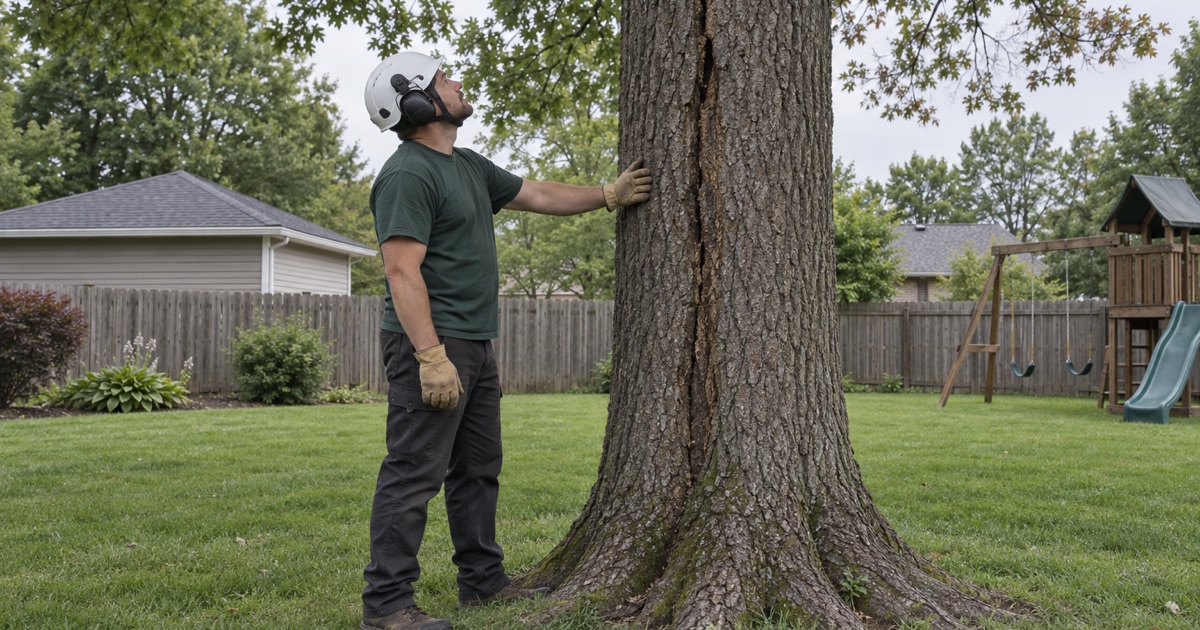
Most residential calls come from one of three things: a storm went through, a neighbor complained, or the tree suddenly looks wrong. We inspect the specific tree and the ground around it rather than the whole yard, and we tell you where it sits on the scale from monitor annually to remove this season. On a Shawnee lot built in the 1980s or 1990s, that frequently means assessing a fast-growing suburban-era species with narrow crotch angles rather than a heritage tree.
HOA, Multifamily and Property Management Inventories
A board or a manager needs something a homeowner does not: a defensible record. We inventory common-area trees, grade each by condition and target, and prioritize the work so a limited budget goes to the trees over the parking stalls and the play equipment first. The document is the point — it demonstrates the association acted on knowledge, which is the exact issue that arises after a failure.
Development, Construction and Tree Preservation Plans
Commercial and subdivision work in this metro turns on credentials rather than on licenses. In Kansas City, Missouri, no land disturbance permit issues before a tree preservation and protection plan is certified by an SAF certified forester, an ISA Certified Arborist, a landscape architect or a professional engineer registered in Missouri, and a sealed letter is required again before final occupancy. In Shawnee the requirement lives in the development review Landscape Plan, which must show every tree twelve inches caliper or larger proposed for removal, measured at four and one-half feet above ground.
What a Tree Risk Assessment Actually Examines
Root Plate, Root Flare and Buttress Roots
The assessment starts at the ground, because that is where the failures nobody sees coming begin. We look for cracked or heaved soil on the upslope side of the trunk, a root flare that has been buried by mulch or regrading, girdling roots circling the stem, and fruiting bodies on buttress roots. Conks at the flare mean decay in the wood that holds the entire tree upright, which is a different category of problem from decay twenty feet up.
Trunk Condition and Heartwood Decay
A cavity is not a verdict. Wood carries load as a hollow cylinder, so what matters is the thickness of sound wood remaining relative to the radius, whether the cavity opens at the base where water collects, and whether the shell is cracked. We probe and sound rather than guess, and we distinguish an old closed wound the tree has walled off from active heartwood decay that is still advancing.
Unions, Included Bark and Co-Dominant Stems
Where two stems of similar diameter rise from the same point, the bark between them can turn inward instead of knitting the union together. That included bark is the defect behind a large share of the splits this metro sees, and it is overrepresented in the fast-growing varieties the Johnson County Extension brochure warns about by name — the Bradford cultivar in particular, which it says splits severely at ten to fifteen years old. Cabling and bracing can extend such a union’s life; nothing repairs it.
The Target, the Likelihood and the Consequence
Risk is not a property of the tree alone. A dead tree in the back of a five-acre parcel and the same tree over a child’s bedroom carry identical defects and completely different urgency. We record what is underneath — structure, drive, play set, utility, or nothing at all — how likely failure is within a stated timeframe, and how bad the consequence would be, because that combination is what an insurer and a court both actually read.
Our Step-by-Step Arborist Assessment Process
Free On-Site Assessment, Booked to the Tree
The visit costs nothing and happens at the property. Tell us which tree and what prompted the call, and we bring the right approach rather than arriving to discover the job needs equipment that is on another truck. If you already have a bid from somebody else, bring it out — we would rather look at a specific claim than talk in generalities.
Ground Inspection and Species Identification
We walk the whole drip line and the critical root zone before looking up, because trenching, paving, regrading and compaction inside that zone explain more declining canopies than pathogens do. ANSI A300 treats root damage within six times the trunk diameter as significant, and on a lot that has had a patio, a pool or a driveway added, that circle is usually where the story is. Species identification comes first, since what is normal for one is a symptom in another.
Canopy, Union and Deadwood Survey
From the ground and, where the tree warrants it, from the canopy, we work through structure systematically: deadwood and its position relative to targets, unions and their attachment, cracks, cankers, epicormic sprouts indicating stress, and any evidence of borers or woodpecker activity that points at decay underneath. Where a decision turns on what is inside the trunk, we say so rather than inferring it from the outside.
Written Findings and a Priced Recommendation
You receive the written condition assessment and, where work is warranted, a figure. The figure we quote is the figure in writing, and it separates the line items — inspection, pruning, cabling, removal, stump grinding, haul-off — so nothing is bundled into a total you cannot interrogate. Where we think a second opinion is worth having, we say that too.
Diagnosis, Treatment and the Written Report
Pests, Pathogens and What Is Actually Wrong
Diagnosis matters because the wrong treatment costs money and time the tree does not have. Emerald ash borer, pine wilt nematode carried by the pine sawyer beetle, Rhizosphaera needle cast on spruce, oak wilt and the various cankers all present differently, and none of them look like the girdling root or construction damage that mimics them. Kansas confirmed its first emerald ash borer detection in 2012, in Wyandotte County, and an untreated ash in this metro is now a removal question rather than a monitoring one.
Retention: Cabling, Structural Pruning and Root Work
Where a tree is worth keeping, the options are real and we price them. Dynamic cabling and extra-high-strength cable with bent-eye lag or eyebolt terminations can support a union that would otherwise fail. Crown cleaning and crown reduction under ANSI A300 reduce load without the epicormic disaster that topping produces. Root collar excavation with an air spade — pneumatic soil excavation that moves soil without cutting roots — finds and frees a girdling root that a shovel would sever.
The Report, and Who Ends Up Reading It
The written assessment is deliberately built to travel. A neighbor disputing a boundary tree, an adjuster deciding whether a loss was foreseeable, an HOA board minuting a decision and a buyer’s inspector flagging a tree at closing all need the same thing: a dated, specific, signed opinion on condition. On the Kansas side, where a neighbor’s obligation turns on substantial harm or imminent danger rather than on annoyance, that document is frequently the whole of the case.
- 20+ Years in Johnson County
- Insured, Proof Sent First
- Free On-Site Assessment