
Shawnee Tree Removal handles tree planting and transplanting across Shawnee, KS, and it is deliberately part of the same business as the removals. Twenty years of taking trees out of this county is an education in what should never have gone in, and almost every removal we do on a house built between 1980 and 2009 is a species that was cheap, fast and structurally doomed from the day it was planted.
That is not a matter of opinion here. The Johnson County K-State Research and Extension Master Gardeners publish a recommended landscape tree brochure for metropolitan Kansas City that names the failures directly: do not plant the Bradford cultivar, because severe splitting occurs on ten to fifteen year old trees, and many fast-growing varieties are brittle with narrow crotch angles that lead to severe breakage during storms. More than half of Shawnee’s housing stock is now in exactly that age window.
So we plant from the county’s own list, put the root flare at grade rather than the pot line at grade, and tell you plainly what a species will do in thirty years rather than what it looks like in the nursery. If a tree does not suit the spot, we say so before it goes in the ground.
Species Selection for This Ground
What the County’s Own List Refuses
The extension brochure is more useful for what it excludes than for what it recommends. Silver maple is out for weak wood, pin oak for soil problems on these soils, green ash for emerald ash borer, Austrian and Scotch pine for disease, and box elder, cottonless cottonwood, European white birch, Lombardy poplar, Siberian elm, silver poplar and willow all appear on the same do-not-plant side. Hackberry is one it actively recommends.
Native Structure Under the Suburbs
Shawnee sits in the Osage Cuestas, and the potential natural vegetation for this ecoregion is upland forest dominated by shagbark and bitternut hickory with red, white and black oak, carrying Ohio buckeye, American bladdernut and pawpaw as understory. That is a useful reference point rather than a prescription — it tells you which broad groups are at home on this ground and which are being asked to tolerate it.
Matching the Tree to the Space It Has
Most planting mistakes are spacing mistakes. A tree that will carry a forty-foot crown planted twelve feet off a foundation becomes a clearance-pruning bill forever and then a removal. We size the mature crown and root spread against the space actually available, including what is overhead — the service drop from the pole to your meter is your responsibility, and planting a shade tree under it guarantees a recurring problem.
Planting Done to the Flare
Finding the Root Flare Before Digging
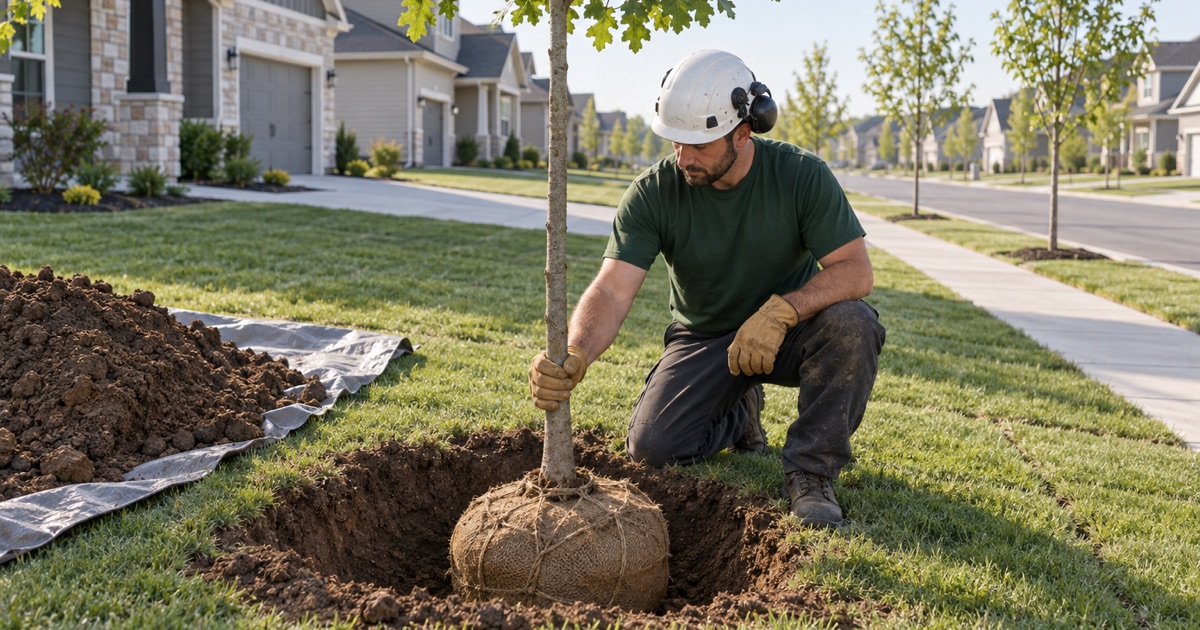
The first thing we do with nursery stock is find where the trunk actually widens into roots, which is often several inches below the surface of the container or the ball. Everything else follows from that: hole depth is set by the flare, not by the pot. A flare buried at planting stays buried for the tree’s life and quietly produces the girdling roots we later diagnose as a mystery decline.
Hole Width, Backfill and What Not to Add
The hole is dug wide and shallow rather than deep and narrow, because roots spread laterally and the surrounding soil is what they have to grow into. We backfill with the site soil rather than building a pocket of imported material the roots will circle inside. On the graded subdivision fill that covers half this city, breaking up the compacted sides of the hole matters more than anything added to it.
Mulch, Staking and Water
Mulch goes in a ring, not a volcano — piled against the trunk it keeps the bark wet and buries the flare all over again. Staking is used only where the tree genuinely cannot stand, and it comes off after a season, because a tree that is never allowed to move never develops the taper that lets it stand alone. We leave you a watering schedule for two growing seasons, which is the part that decides whether the planting worked.
Transplanting an Established Tree
When a Move Is Realistic
Transplanting is governed by the ratio between the stem and the root ball that can be lifted with it. Small and moderate trees move well; large ones lose too high a proportion of their roots to recover. We assess the species, the age, the existing root situation and the access at both ends, and we will tell you when the honest answer is to remove the tree and plant a better one in the new spot.
Protecting the Roots of Trees You Are Keeping
Anything you plant near existing trees, and any construction happening around them, has to respect the critical root zone. ANSI A300 treats root damage within six times the trunk diameter as significant, and that circle is much larger than most people picture. Trenching for irrigation, a new patio edge or a driveway widening inside it is a slow removal nobody scheduled.
Aftercare, and Correcting What Went Wrong Earlier
Where an existing tree is already declining from a buried flare or a girdling root, the fix is root collar excavation using an air spade — pneumatic soil excavation that removes soil without cutting roots — so the flare can be exposed and the offending root dealt with. It is a genuine alternative to a removal, and on a tree worth keeping it is the cheaper of the two by a wide margin.
- 20+ Years in Johnson County
- Insured, Proof Sent First
- Free On-Site Assessment