
Shawnee Tree Removal has been doing land and lot clearing out of Shawnee, KS for more than twenty years, serving surrounding cities including Lenexa, Edwardsville, Bonner Springs, Merriam and Mission. It is a different trade from taking down a yard tree: different machines, a different unit of measure, and a set of questions about permits, disposal and ground conditions that have to be answered before anything starts moving.
The metro we work in makes that particularly true. Inside the Johnson County suburbs a lot clearing job is usually a building pad, a fence line or an overgrown back half of a residential parcel, with tight access and neighbors on both sides. Push west and south and the same phrase means acreage: old Osage orange hedge rows planted as living fence, bush honeysuckle that has swallowed a wooded property line, and volunteer growth on ground that stopped being grazed twenty years ago.
We price by the area and the density, walk the parcel before quoting, place the utility locate, and settle the disposal route and any burn permit in advance. Every stick that leaves goes to a gate documented to accept it, and the figure we give you is the figure in writing.
Residential Lot Clearing and Commercial Site Work
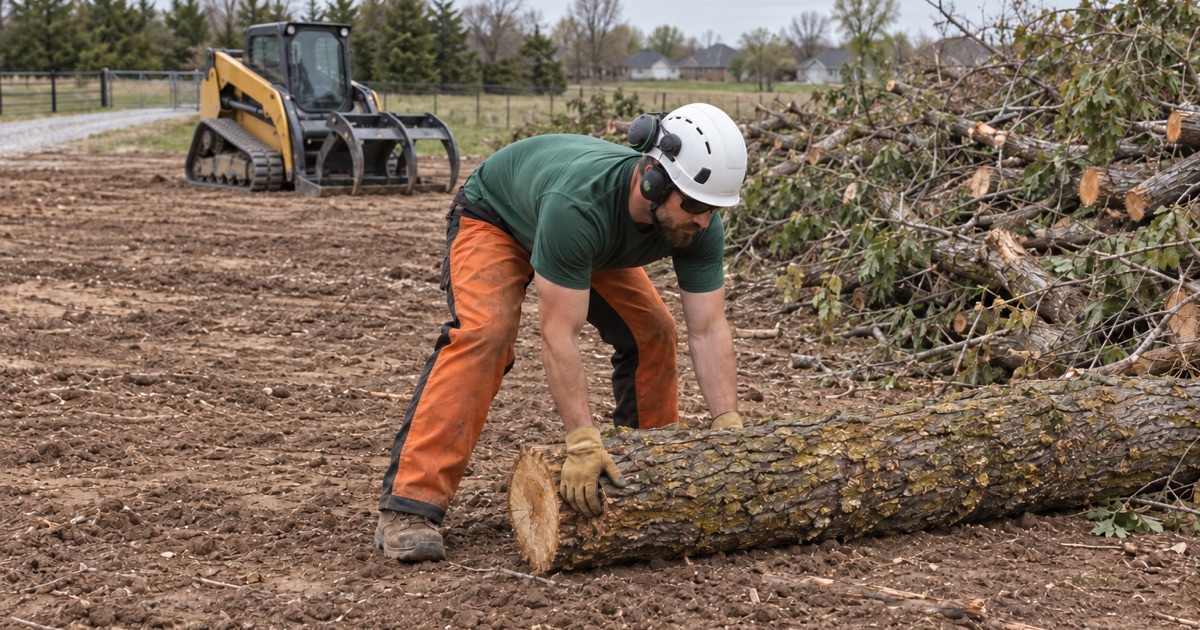
Building Pads, Additions and Pool Excavations
Clearing for construction has a hard requirement the rest of this work does not: the ground has to be genuinely clear, roots included, because a foundation or a slab poured over decaying root mass settles unevenly. That means grubbing rather than mulching across the footprint, spoil handled as spoil, and a clean boundary between the cleared area and the trees you are keeping. Trees left standing near the work need their critical root zone protected, since ANSI A300 treats root damage within six times the trunk diameter as significant.
Fence Lines, Trails and Pasture Reclamation
On rural and semi-rural parcels most clearing is linear or selective rather than total. A fence line that has not been maintained in a decade, a trail through a wooded parcel, a pasture edge that has crept in twenty feet — these suit mulching, because the material can stay where it falls and the ground is barely disturbed. We clear to a stated width and leave a defined edge you can maintain from then on.
Commercial Sites, Detention Areas and Right-of-Way Corridors
Commercial clearing usually comes with paperwork attached. On a Kansas City, Missouri site the tree preservation ordinance applies to land disturbance of one acre or more and to building permits disturbing more than ten thousand square feet where no development plan is otherwise required, and the plan has to be certified by a named credential before any land disturbance permit issues. We will tell you when your parcel is inside that trigger and when it is not.
Methods: Forestry Mulching, Grubbing and Hauling
Forestry Mulching
The mulching head grinds standing material in place and leaves a mat that suppresses regrowth for a season and breaks down into the soil. It is the fastest and least disruptive method available on suitable ground, it produces no burn pile and no haul bill, and it leaves a surface you can walk immediately. Its limits are stem diameter, slope, and any site where a mulch layer is unwelcome.
Cut, Chip and Haul
Where the material cannot stay — a small lot with neighbors, a site that has to be finished clean, or a parcel where the mulch mat would end up in a drainage feature — we cut, chip what will chip and haul the rest. This is the more expensive method for a reason: chipping capacity and truck cycles set the pace, and a full-size towed chipper is over seven feet wide, which decides where it can be positioned.
Grubbing and Root Removal
Grubbing takes out the root mass with an excavator or a dozer and is the only method that genuinely clears ground for construction. It moves a great deal of material, generates spoil mixed with soil, and leaves a surface that will need grading. It is also the method most likely to find something buried, which is why the locate and a slow first pass matter.
Hedge Row Removal
The old Osage orange hedge rows across eastern Kansas were planted as living fence and behave exactly like one: dense, thorny, interlocked at the base and famously hard on equipment. The wood is heavy and slow to grind, and the hedge balls foul a mower for years afterward. These come out as a linear job priced by the row and the number of passes, not tree by tree.
Our Step-by-Step Land Clearing Process
Site Walk and Scope
We walk the parcel with you, agree the boundary of the work in the field rather than on a map, identify anything staying — specimen trees, a fence, a well head, a septic field — and record the access route the equipment will use. That walk is what turns an acreage figure into a real price, and it costs nothing.
Utility Locate and Access Preparation
The 811 locate goes in and the marks set the clearing pattern. Access gets prepared before the machines arrive: the entry point stabilized where the ground is soft, gates widened or temporarily removed, and a staging area chosen where the trucks are not blocking a road or a neighbor.
Clearing in Passes, With the Keepers Protected
The work runs in passes rather than in one sweep, taking the understory first so the operators can see what they are dealing with, then the stems in size order. Trees you are keeping get their root zones fenced or matted so equipment does not compact the ground inside the drip line, which is damage that shows up two summers later rather than on the day.
Final Grade, Cleanup and Handover
The finish depends on what the ground is for. A pasture edge gets left with a mulch mat and a clean line; a building pad gets grubbed, spoiled off and rough graded; a residential lot gets raked and the perimeter cleaned of throw. We walk it with you at the end and you sign off on the same boundary we agreed at the start.
Permits, Burning and Disposal on Kansas and Missouri Acreage
Burn Permits Are Local, Not Regional
There is no single answer for burning across this metro, and assuming your county’s rule applies on the other side of a line is how a clearing job acquires a fine. Miami County issues burn permits through Fire Districts 1 and 2 with county emergency management, free but conditional, with a stated penalty for violations. Inside most city limits burning is simply not available. We check the specific jurisdiction and tell you before the schedule is set.
Where Cleared Material Is Allowed to Go
Disposal is a real line on a clearing quote because the free residential routes are closed to a contractor hauling your material. Shawnee’s own landfill voucher is one per household per year and restricted to residents showing proof of residency, and the Olathe compost site is posted for Olathe residents only. The route that reliably takes brush and trunk wood prices by the cubic yard and has its own limits on log size and on dirt-laden stumps.
Airport Overlays and Other Height Constraints
On acreage near a public field, what may be left standing is not entirely your choice. Kansas counties adopt airport zoning under K.S.A. 3-703, and those overlay districts treat a tree as an obstruction subject to height limits exactly as they would a structure, with approach surfaces widening outward from the runway. It is an easy constraint to miss on a rural parcel and an expensive one to discover after planting.
- 20+ Years in Johnson County
- Insured, Proof Sent First
- Free On-Site Assessment